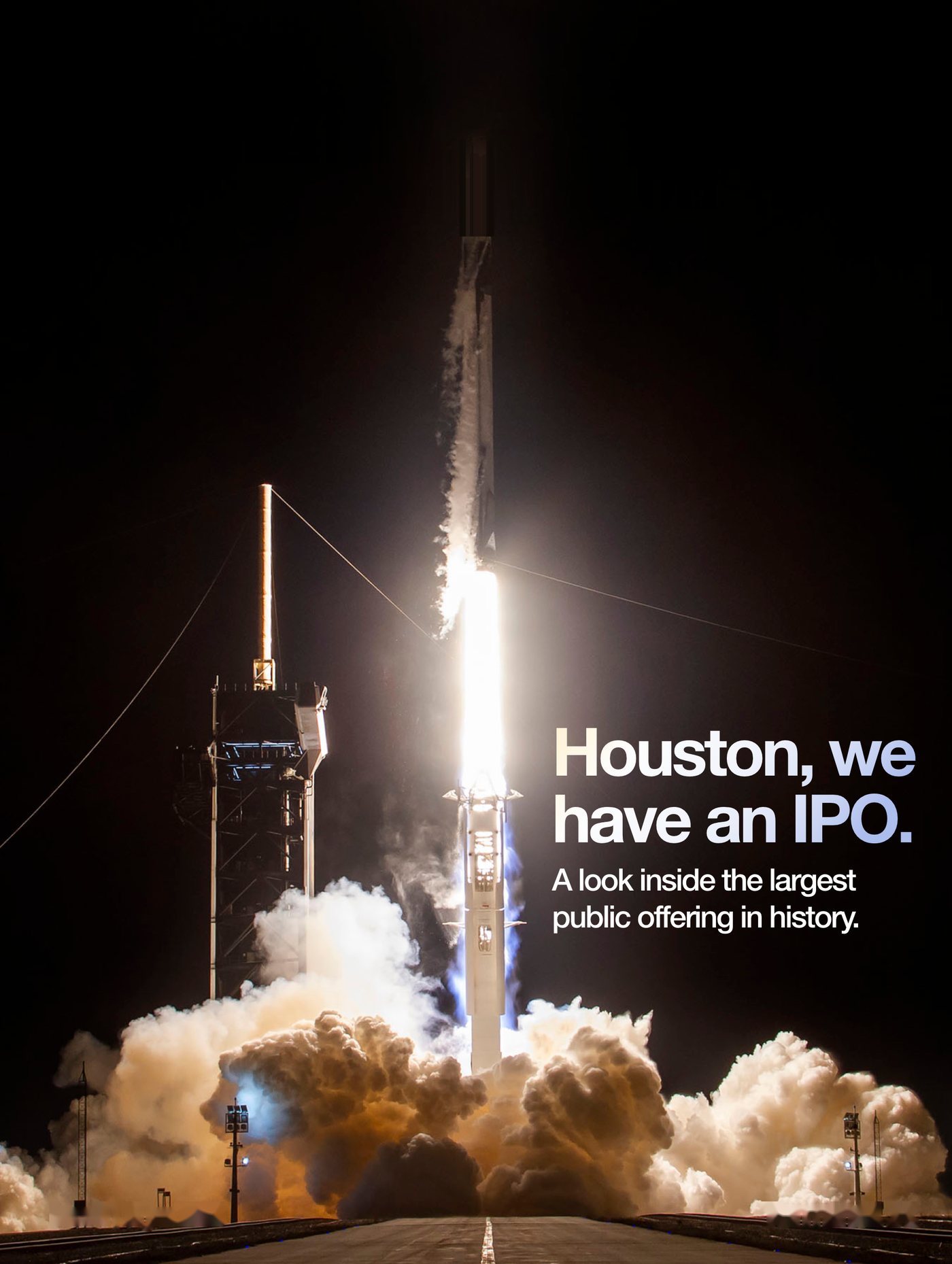
- A record deal: SpaceX priced at $135 a share and raised about $75 billion, or about $86 billion with the extra shares sold to underwriters.
- Starlink pays the way: Connectivity made $11.4 billion of 2025’s $18.7 billion revenue, about 61%.
- AI changed the profile: After buying xAI, SpaceX reported a 2025 net loss of $4.9 billion and $29.1 billion of long-term debt by March 2026.
- Volatility arrived quickly: Shares closed up about 19% on day one, reached $211, then fell below the IPO price by mid-July.
- Supply is still to come: Lock-ups for other pre-IPO investors run 180 days on a staggered basis, and 366 days for Musk and other insiders.
Executive Summary
SpaceX began trading on Nasdaq under the ticker SPCX on June 12, 2026, in the largest IPO on record. The filing gave investors their first full look at a company that combines rockets, satellite broadband and, after its xAI acquisition, an expensive AI business.
The financials show three very different businesses under one share price. Starlink is the growth engine. The launch business provides strategic strength but carries heavy Starship spending. The AI segment brings revenue, but also large losses and capital needs.
The conclusion: The important question is not how large the IPO was. It is what the share price assumes about Starlink’s growth, future Starship economics and the AI business. Investors should value those separately before thinking about the company as a whole.
The Offering
| Item | Detail |
|---|---|
| Offer price | $135 per share |
| Base raise | About $75 billion, from more than 555 million shares |
| With over-allotment | About $86 billion |
| Listing | Nasdaq, SPCX, June 12, 2026 |
| First-day close | About $161, up about 19% |
| Market value at first close | About $2.1 trillion |
| Share classes | Class A has 1 vote, Class B has 10 votes |
| Musk’s position | About 42% of shares and about 82% of votes |
Musk’s voting control means public shareholders have limited influence over the company’s direction, including how much capital goes to AI.
The 2025 Numbers
| Measure | 2025 |
|---|---|
| Total revenue | $18.7B |
| Loss from operations | $2.6B |
| Net loss | $4.9B |
| Adjusted EBITDA | $6.6B |
| Long-term debt, end of March 2026 | $29.1B |
The gap between $6.6 billion of adjusted EBITDA and a $4.9 billion net loss deserves attention. Adjusted EBITDA excludes depreciation, among other items, and that is a real long-term cost for a business that must keep replacing satellites and building data centres.
Late in June, SpaceX also sold about $25 billion of bonds, upsized from an initial $20 billion, which adds to its financing needs.
Reading the Three Businesses
| Segment | 2025 revenue | Main question |
|---|---|---|
| Connectivity (Starlink) | $11.4B | Can growth outrun falling revenue per user? |
| Space | $4.0B | When does Starship spending pay off? |
| AI (xAI) | $3.2B | Can revenue justify the capital and losses? |
Connectivity
| Starlink | 2023 | 2024 | 2025 | March 2026 |
|---|---|---|---|---|
| Subscribers | 2.3M | 4.4M | 8.9M | 10.3M |
Subscriber growth has been remarkable. Monthly revenue per user, however, fell from $99 in 2023 to $66 by the end of March 2026. That can be a healthy trade if lower prices open new markets, but the mix of customers will matter as growth moves to lower-income regions.
Space
The Space segment includes launch and NASA crew services. It earned about $4 billion of revenue and spent nearly $3 billion on research and development, mostly for Starship. Investors are effectively paying today for a vehicle whose economics are not yet proven at scale.
AI
The AI segment brought $3.2 billion of revenue in 2025. It is also the main reason for the loss profile, which is why secondary coverage describes Starlink profits as funding AI spending. Investors in SPCX are therefore also investors in an AI build-out, whether that was their main reason for buying or not.
What the Valuation Assumes
At about $2.1 trillion, the first-day value was roughly 112 times 2025 revenue. That is an arithmetic comparison, not a forecast, and revenue is growing quickly. It does show how much future success the price already assumed.
| Scenario question | Why it matters |
|---|---|
| Does Starlink keep growing while revenue per user falls? | It is the largest and clearest source of value |
| Does Starship lower launch costs at scale? | It affects capacity and future businesses |
| Does AI spending earn a return? | It affects cash flow and debt |
| Does capital spending fall as a share of revenue? | It decides when profit becomes free cash flow |
Trading After the IPO
| Date | Share price |
|---|---|
| IPO price, June 11 | $135 |
| First-day close, June 12 | About $161 |
| Peak, the week after listing | $211 |
| Mid-July | About $123–125 |
| Late July | About 50% below the peak |
Those are figures from the first weeks of trading, so readers should check current prices. The rapid move matches what research on IPOs has long warned about. Ritter’s 1991 study found that newly listed companies tended to lag comparable firms over the following years, although that is an average and says nothing certain about any one company.
Float, Lock-ups and Index Rules
Only a small part of the company could trade at first, which can make prices more volatile. About 30% of the deal was reported to go to retail investors, an unusually large share.
More shares can reach the market over time. Other pre-IPO investors face 180-day lock-ups on a staggered schedule, with some early release tied to milestones, while Musk and other insiders face 366 days. Index rules matter too. Nasdaq-100 entry was possible about 15 trading days after listing under a rule changed in March 2026, while the S&P 500 still requires 12 months of trading and four consecutive profitable quarters.
Final Verdict: What the Numbers Say
| Question | Current reading |
|---|---|
| Strongest business | Starlink, at about 61% of revenue |
| Biggest financial drag | The AI segment |
| Largest unproven bet | Starship economics at scale |
| Biggest governance issue | Musk’s voting control |
| Near-term share supply | Staggered lock-up expiries |
SpaceX is a rare mix of real scale and very large unproven bets. The IPO’s size made headlines, but the filing’s most useful message is simpler: Starlink is working, Starship is expensive, and AI is consuming large amounts of capital. Any view on the shares should begin with those three facts.
This note is general information, not investment advice or a recommendation to buy, sell or hold any investment.
- SpaceX (2026). Form S-1 registration statement, as reported by Via Satellite, 20 May and 3 June 2026.
- NPR (2026). SpaceX IPO makes history as largest ever. Stock gains 19% on first day, 12 June 2026.
- NBC News (2026). SpaceX stock gains 19% its first trading day, closing out a historic IPO.
- Wikipedia (accessed November 2026). Initial public offering of SpaceX, used for lock-up, index and later price details, with the sources it cites.
- Ritter, J. R. (1991). The long-run performance of initial public offerings. The Journal of Finance, 46(1), 3–27.